

Exploring Early Education: What Are the Key Alternatives to Montessori?
Meta Description: Is Montessori not the right fit for your child? Explore the top alternatives to Montessori education, including Waldorf, Reggio Emilia, Playway, and Traditional methods.
Montessori is undoubtedly one of the most famous educational philosophies in the world. Its focus on independence, hands-on learning, and child-led discovery has made it a top choice for millions of parents.
However, there is no such thing as a one-size-fits-all approach to education. Some children thrive in the quiet, structured independence of a Montessori classroom, while others need more imaginative play, teacher-led guidance, or collaborative group work.
If you are exploring preschools and wondering what else is out there, here is a breakdown of the key alternatives to the Montessori method.
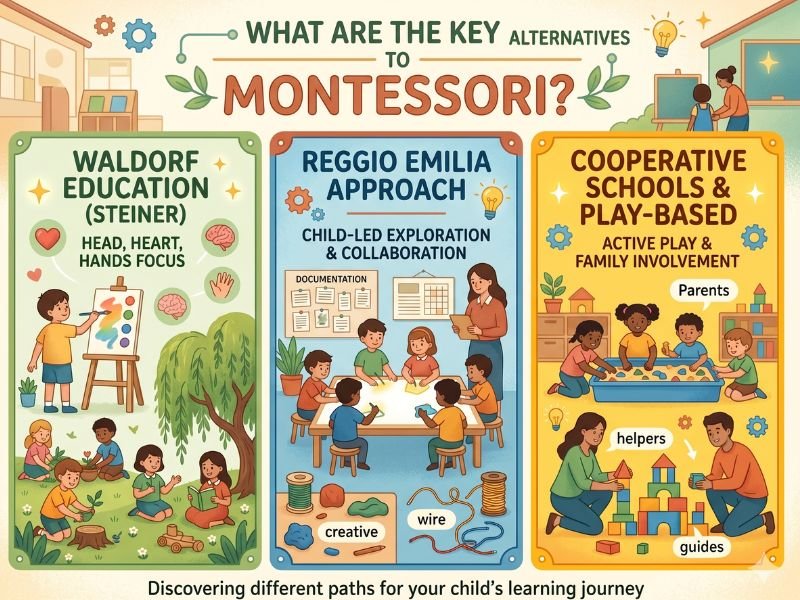
1. The Waldorf (Steiner) Method
Developed by Rudolf Steiner, the Waldorf philosophy is heavily focused on imagination, creativity, and holistic development. It is often seen as the most “arts-integrated” alternative to Montessori.
-
The Core Philosophy: Waldorf strongly delays formal academics (like reading and math) until the age of six or seven. Instead, the early years are dedicated almost entirely to imaginative play, arts, music, and nature.
-
The Classroom: You will find classrooms filled with natural, open-ended toys (like simple wooden blocks or faceless dolls) designed to make the child use their imagination. There is a strong emphasis on rhythm and routine, with activities like baking, gardening, and storytelling.
-
Best For: Creative, highly imaginative children who thrive in a warm, family-like environment without early academic pressure.
2. The Reggio Emilia Approach
Originating in Italy after World War II, the Reggio Emilia approach is famous for its project-based, collaborative style of learning.
-
The Core Philosophy: Children are viewed as highly capable “co-constructors” of knowledge. Learning is heavily project-based, stemming entirely from the interests of the children in the room. If a child finds a snail outside, the entire class might spend a month researching, painting, and studying snails.
-
The Environment: Reggio famously considers the physical environment to be the “third teacher” (after parents and educators). Classrooms are beautiful, light-filled, and designed to encourage social collaboration.
-
Best For: Inquisitive, social children who love working with others, asking big questions, and expressing themselves through art and building.
3. The Playway Method
The Playway method is incredibly popular across India and many parts of the world for nursery and kindergarten education. It was championed by educators like Friedrich Fröbel (the inventor of Kindergarten).
-
The Core Philosophy: As the name suggests, the core belief is that children learn best through unstructured and guided play. Academics are introduced, but always wrapped in a game, a song, or a physical activity.
-
The Classroom: Playway classrooms are usually bright, energetic, and full of colorful toys, music, and movement. Activities change frequently to match the short attention spans of toddlers.
-
Best For: Energetic children who learn best through movement, songs, and highly interactive, fun environments.
4. Traditional (Mainstream) Education
While “alternative” philosophies get a lot of attention, traditional, teacher-led preschools remain the most common choice globally.
-
The Core Philosophy: The teacher is the clear authority and guide. The day follows a set schedule, and all children learn the same concepts at the same time. There is an early focus on academic readiness, such as learning the alphabet, numbers, and basic writing skills.
-
The Classroom: Desks or tables are usually arranged facing the teacher. The curriculum is structured, predictable, and heavily focused on preparing children for the academic rigors of primary school (such as transitioning into a CBSE or ICSE board).
-
Best For: Children who thrive on clear rules, structure, and direct instruction, and parents who want a strong early focus on academic milestones.
A Quick Comparison: Montessori vs. The Alternatives
To help you visualize the differences, here is how they stack up on a few key factors:
| Philosophy | Focus on Academics | Role of Imagination / Fantasy | The Teacher’s Role |
| Montessori | High (Introduced early via physical materials) | Low (Focuses on real-world practical life) | Unobtrusive Guide |
| Waldorf | Low (Delayed until age 7) | Very High (Fairytales, arts, and roleplay) | Nurturing Role Model |
| Reggio Emilia | Medium (Learned through long-term projects) | High (Expressed through art and building) | Co-learner / Collaborator |
| Traditional | Very High (Worksheets, rote learning) | Medium (Usually relegated to “recess” time) | Director / Instructor |
Making the Right Choice
Choosing the right early education philosophy comes down to understanding your child’s unique personality.
If they are fiercely independent and love order, Montessori is brilliant. If they are dreamers who love art, Waldorf might be the key. If they are natural researchers who love working in groups, look into Reggio Emilia.
Which of these philosophies feels like the closest match for your child’s natural learning style?