


Choosing the right educational path for your child is one of the most profound decisions you will make as a parent. In the early years of a child’s life, their brain is developing at a staggering, unrepeatable rate. The environment they are placed in during this critical window does not just determine what they learn; it fundamentally shapes how they learn, how they view themselves, and how they interact with the world around them.
As you begin touring preschools and elementary schools, you will likely encounter two dominant educational philosophies: the standard, traditional model that most of us grew up with, and the Montessori method, an approach that has gained immense global popularity.
At a passing glance, both environments aim to educate children, but beneath the surface, they represent two radically different philosophies of human development.
Are you wondering which system will best nurture your child’s unique potential? In this comprehensive guide, we will deeply explore the origins, philosophies, and practical, day-to-day differences between Montessori and traditional education.
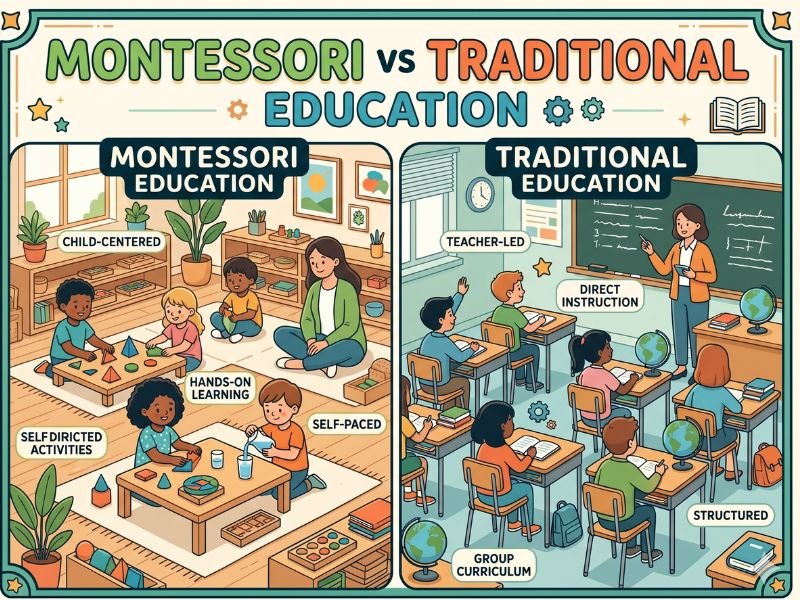
Understanding the Two Philosophies
Before we compare the day-to-day mechanics of these two systems, it is essential to understand the historical context and the core philosophies that drive them.
What is Traditional Education?
The traditional education system as we know it today has its roots in the Industrial Revolution. In the 19th and early 20th centuries, there was a sudden need to educate large masses of children simultaneously to prepare them for factory work and standardized labor. The system was designed for maximum efficiency.
The Core Philosophy: Traditional education is primarily adult-led and system-centered. It operates on the premise that children are “blank slates” or empty vessels waiting to be filled with knowledge by an expert (the teacher). The state or the educational board determines a fixed curriculum, and it is the teacher’s job to deliver that curriculum to a room full of children at the exact same time. Success is measured by how well the child can memorize, retain, and repeat this information on standardized tests.
What is Montessori Education?
The Montessori method was born from science and medicine, not industrial efficiency. It was developed in 1906 by Dr. Maria Montessori, Italy’s first female physician. Through rigorous, scientific observation of children in Rome, she discovered that children learn best not when they are forced to sit and listen, but when they are allowed to move, touch, and follow their natural curiosity.
The Core Philosophy: Montessori education is deeply child-centered. It operates on the premise that children are naturally eager for knowledge and capable of initiating learning in a supportive, thoughtfully prepared environment. The method respects the child as an individual with their own unique timeline for development. Instead of molding the child to fit the curriculum, the environment and the curriculum are molded to fit the child.
The 7 Key Differences Between Montessori and Traditional Education
If you spend a morning observing a traditional kindergarten and then walk into a Montessori “Children’s House,” the contrast is immediate and striking. Here are the seven fundamental differences between the two environments.
1. Classroom Structure and Age Groupings
Traditional: Same-Age Classrooms
In traditional schools, children are grouped strictly by chronological age. All four-year-olds are in one room, all five-year-olds in another. The underlying assumption is that children of the exact same age have the exact same developmental needs and should learn the same concepts at the same time. This can lead to frustration for children who are advanced and boredom for those who need more time, as the teacher must teach to the “middle” of the pack.
Montessori: Mixed-Age Classrooms
Authentic Montessori classrooms group children in three-year age spans (e.g., ages 3 to 6, 6 to 9, and 9 to 12). This structure intentionally mimics a family or a real-world community.
-
The Benefit: Younger children learn rapidly by observing the older children. Older children, in turn, cement their own knowledge and build immense leadership skills and empathy by helping the younger ones. Furthermore, because a child stays in the same room with the same teacher for three years, the teacher develops a profound, nuanced understanding of that child’s unique personality and learning style.
2. The Role of the Teacher
Traditional: The Sage on the Stage
In a standard classroom, the teacher is the focal point. They stand at the front of the room, deliver lessons to the entire group, set the pace of the day, and enforce the rules. The teacher is the active giver of information, and the students are the passive receivers. The teacher dictates when it is time for math, when it is time to read, and when it is time to use the restroom.
Montessori: The Guide on the Side
In a Montessori setting, the teacher is referred to as a “guide.” They rarely stand at the front of the room. Instead, you will find them sitting on the floor, working quietly with one child or a small group of two or three. The guide’s primary job is rigorous observation. They watch to see what each child is interested in and what developmental stage they are entering. Based on these observations, the guide gently introduces new lessons tailored specifically to that child’s readiness.
3. Curriculum and the Pace of Learning
Traditional: Standardized and Time-Bound
Traditional curriculums are predetermined by a school board. On any given Tuesday in October, the curriculum dictates that the entire class must learn about the letter “B” and basic addition. The class works on this for a set period (e.g., 45 minutes). When the bell rings, math is over, and everyone must move on to reading, regardless of whether a child has mastered the math concept or was right in the middle of a breakthrough.
Montessori: Child-Led and Flexible
Montessori allows for “freedom within limits.” Upon entering the classroom, a child chooses their own “work” from the shelves. If a four-year-old wants to spend three uninterrupted hours mastering a complex puzzle or working on a math material, they are entirely free to do so. This extended, uninterrupted block of time (typically a 3-hour work cycle) allows children to achieve states of deep concentration and “flow,” fostering a genuine love for learning rather than a rushed attempt to beat the clock.
4. Learning Materials and Environment
Traditional: Textbooks, Worksheets, and Technology
Learning in a conventional school is highly abstract. Children are taught concepts via blackboards, flashcards, workbooks, and increasingly, smartboards and tablets. The environment is heavily decorated by the teacher, often with brightly colored posters, alphabet borders, and student artwork plastered on every wall.
Montessori: Sensorial, Hands-On, and Minimalist
A Montessori classroom—known as a “prepared environment”—is intentionally minimalist, calm, and uncluttered. The materials are entirely tactile and physical. Dr. Montessori believed that “the hands are the instruments of man’s intelligence.”
-
Self-Correcting Materials: Children do not learn math by looking at numbers on a page; they hold and count physical “Golden Beads” to understand the weight and size of a thousand versus a ten. They learn to write by tracing textured “Sandpaper Letters.” Furthermore, these materials are designed to be self-correcting. If a child builds a tower incorrectly, it falls over. They do not need a teacher to tell them they made a mistake with a red pen; the material itself guides them to try again.
5. Motivation, Assessment, and Grades
Traditional: Extrinsic Motivation (Grades and Rewards)
The traditional system relies heavily on extrinsic (external) motivators to ensure compliance and effort. Children are motivated by gold stars, sticker charts, the threat of timeouts, and eventually, letter grades (A, B, C, D, F). While this can produce short-term compliance, psychological studies show that heavily rewarding a child for a task actually decreases their long-term, natural interest in that task.
Montessori: Intrinsic Motivation (Mastery and Joy)
You will not find a single sticker chart, grade book, or gold star in a true Montessori classroom. The method relies entirely on intrinsic (internal) motivation. The reward for completing a difficult puzzle is the immense, internal feeling of pride and mastery the child experiences. Because they are allowed to choose work that naturally interests them, they do not need to be bribed to learn. Assessment is continuous and observational, kept in detailed logs by the guide, rather than delivered via stressful standardized testing.
6. Discipline and Classroom Management
Traditional: Teacher-Enforced Rules
Discipline in a conventional setting is top-down. The teacher sets the rules, and if a child breaks them, the teacher issues a punishment (loss of recess, timeouts, trips to the principal). The focus is often on managing behavior to keep the group quiet and compliant.
Montessori: Self-Regulation and Logical Consequences
Montessori focuses on teaching self-discipline and emotional regulation. Because children have the freedom to move around the room and talk quietly with peers, there is less pent-up energy leading to misbehavior. When conflicts arise, guides help children use a “Peace Table” to talk through their feelings and resolve the issue together. Consequences are logical, not punitive. If a child spills water, the consequence is not a timeout; the consequence is that they must fetch a towel and clean it up.
7. Social Development and Collaboration
Traditional: Socializing During Recess
In a traditional room, children are generally expected to sit at their own desks, keep their eyes on their own paper, and remain quiet during lessons. Socialization is strictly relegated to designated times, such as recess, lunch, or specific group projects dictated by the teacher.
Montessori: Organic, Continuous Collaboration
Montessori classrooms are buzzing, dynamic social communities. Because children are free to move and work where they please (at a table or on a floor mat), they organically collaborate all day. A younger child might ask an older child for help tying their shoes or carrying a heavy tray. Two children might decide to work together on a giant map puzzle. This constant, fluid interaction builds incredibly high levels of social grace, courtesy, and emotional intelligence.
Part 3: Deep Dive Comparison Table
For a quick summary of the core differences discussed above, refer to this side-by-side comparison:
| Feature | Traditional Education | Montessori Education |
| Pacing | Teacher-paced; everyone learns at the same time. | Child-paced; individualized learning timelines. |
| Curriculum | Fixed, state-mandated, textbook-driven. | Flexible, child-led, interest-driven. |
| Environment | Desks, smartboards, adult-sized furniture. | Open floor space, child-sized furniture, tangible materials. |
| Motivation | Grades, stickers, praise, fear of failure. | Internal satisfaction, love of discovery, natural curiosity. |
| Class Make-up | Same-age peers (grouped by birth year). | Mixed-age peers (grouped in 3-year spans). |
| Teacher Focus | Group-focused (teaching the whole class). | Individual-focused (one-on-one or small group lessons). |
| Discipline | External rewards and punishments. | Internal self-regulation and natural consequences. |
Part 4: The Pros and Cons of Each System
No educational system is perfect, and what works beautifully for one child may not be the ideal fit for another. It is important to look objectively at the strengths and potential drawbacks of both approaches.
The Traditional Method
The Pros:
-
Predictability and Consistency: Traditional schools offer a highly structured environment. Parents know exactly what their child is learning and how they are performing relative to state standards.
-
Widespread Availability: This is the default system worldwide. It is easy to find, and transferring from one traditional school to another in a different city is generally a seamless process.
-
Preparation for Standardized Society: Because society, universities, and many corporate jobs operate on standardized timelines and external metrics, traditional education heavily prepares children for this reality.
The Cons:
-
A “One-Size-Fits-All” Approach: Children who learn faster can become deeply bored and act out. Children who learn slower can feel “stupid,” leading to a lifelong hatred of school.
-
Stifles Creativity: The heavy focus on rote memorization and standardized testing leaves little room for creative problem-solving or out-of-the-box thinking.
The Montessori Method
The Pros:
-
Deep Fosters Independence: Montessori children are famous for their remarkable self-reliance. They learn to manage their time, care for their environment, and advocate for themselves from toddlerhood.
-
Ignites a Genuine Love for Learning: By removing the pressure of tests and allowing children to follow their passions, school becomes a place of joy and discovery, not stress and compliance.
-
Highly Individualized: Your child will never be held back by the rest of the class, nor will they be dragged forward before they are ready. They receive a custom-tailored education.
The Cons:
-
Quality Control: The name “Montessori” was never trademarked. Therefore, any school can slap the word on their building, even if they do not follow the philosophy. Parents must do rigorous research to find authentic, accredited programs (look for AMI or AMS affiliations).
-
Transitioning Can Take Time: If a child moves from a Montessori elementary school to a traditional high school, the sudden introduction of rigid schedules, sitting at desks all day, and letter grades can cause temporary culture shock.
Part 5: Frequently Asked Questions (FAQs)
1. Is Montessori too unstructured? Will my child just play all day?
A common misconception is that Montessori is a “free-for-all.” In reality, it features “freedom within limits.” The environment is highly structured by the guide behind the scenes. Children are free to choose their work, but they are not free to run wild, disrupt others, or destroy materials. They are expected to complete cycles of work and master core academic concepts.
2. How do Montessori children transition to traditional schools later on?
Research consistently shows that Montessori students transition quite well. Because they have spent their early years developing strong executive functioning skills—like time management, self-regulation, and independent focus—they are often highly adaptable. They generally view the traditional structure as just another system to learn and master.
3. Do traditional schools completely ignore individual learning styles?
Not necessarily. Modern traditional education has evolved. Many excellent traditional teachers work hard to incorporate visual, auditory, and kinesthetic learning styles into their lesson plans and offer “differentiated instruction.” However, they are still fundamentally constrained by the requirement to teach the entire class the same curriculum within a strict timeframe.
4. Is Montessori only for gifted children?
No. Montessori was actually originally developed to help children with learning disabilities who were left behind by the traditional system. Because the method is entirely individualized and relies on hands-on materials rather than abstract lectures, it is incredibly effective for children across the entire spectrum of neurodiversity—from gifted children to those with ADHD or dyslexia.
Conclusion: Making the Right Choice for Your Child
When it comes down to the wire, the debate between Montessori and traditional education is not about which system is definitively “better” in a vacuum. It is about which system aligns best with your child’s personality, your family’s values, and your vision for their future.
Traditional education provides a clear, structured, and predictable path with universally understood metrics for success. It trains children to function well within established systems.
Montessori education, on the other hand, offers a profoundly respectful, individualized approach that prioritizes emotional intelligence, fierce independence, and a lifelong, burning curiosity about the world.
The best advice for any parent standing at this crossroads? Step away from the computer and step into a classroom. Schedule a tour of an authentic Montessori school and a highly-rated traditional school in your area. Observe the children. Look at their faces, listen to the volume of the room, and watch how the teachers interact with them. Often, your parental intuition will know exactly which environment your child was meant to thrive in.