

What is Montessori Education? The Ultimate Guide for Parents
Meta Description: Wondering “What is Montessori education?” Explore our complete guide covering the Montessori method, its core benefits, and how it compares to traditional schooling.
Are you exploring school options for your child and keep hearing the word “Montessori”? You are not alone.
As parents look for alternatives to high-pressure, test-focused schooling, the Montessori method has seen a massive surge in popularity. But despite its fame, many parents still ask: What exactly is Montessori education?
Is it a strict curriculum? Is it just a room full of wooden toys? Or is it a free-for-all where kids do whatever they want?
In this comprehensive guide, we will break down the science, the philosophy, and the incredible benefits of the Montessori method in simple, easy-to-understand terms.
What is the Montessori Method? A Quick Definition
Montessori education is a child-centered approach to learning developed by Dr. Maria Montessori in the early 1900s.
Instead of forcing a child to adapt to a rigid curriculum, the Montessori method adapts the learning environment to fit the child. It is based on the scientific observation that children learn best when they are given the freedom to follow their natural curiosity at their own pace.
There are no traditional grades, no standard tests, and no teachers lecturing at the front of a room. Instead, learning happens through hands-on discovery.
The 5 Core Pillars of a Montessori Classroom
If you walk into an authentic Montessori school, it will look and feel very different from a traditional classroom. Here are the five key elements that make it unique:
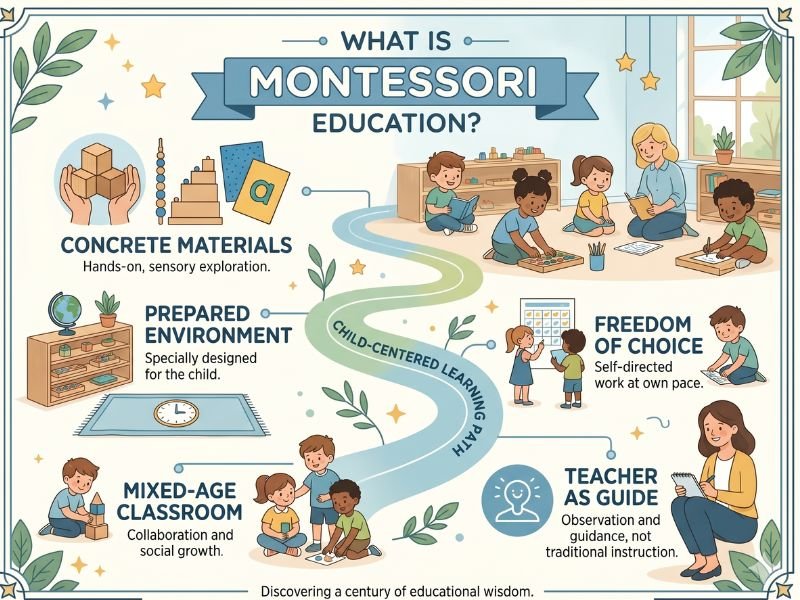
1. Child-Led, Self-Directed Learning
In traditional schools, the teacher decides what everyone learns today. In Montessori, the child takes the lead. Students are given “freedom within limits.” They can choose an activity from a carefully selected range of options and spend as much time on it as they need to master it.
2. The “Prepared Environment”
A Montessori classroom is meticulously organized to foster total independence. Everything is scaled down to the child’s size. You will see low, open shelves, child-sized brooms, and tiny sinks. This design empowers children to access materials, clean up spills, and navigate their day without constantly asking adults for help.
3. Hands-On, Tactile Materials
Montessori does not rely on abstract textbooks. Learning is achieved through specialized, physical materials.
-
Math: Children hold and count physical “golden beads” to understand addition.
-
Language: Children trace “sandpaper letters” to feel the shape of the alphabet before writing.
These materials are “self-correcting”—meaning the child can see their own mistakes and try again independently.
4. Mixed-Age Classrooms
Authentic Montessori classrooms group children in three-year age spans (for example, ages 3 to 6). This mimics a real-world community. Older children naturally step into leadership roles by mentoring the younger ones, which reinforces their own knowledge and builds deep empathy.
5. Teachers as “Guides”
In Montessori, the teacher is not a boss; they are an observer and a facilitator (often called a “guide”). They closely monitor each child’s progress. When a child is ready for a new challenge, the guide gently introduces the next lesson, ensuring the child is never bored and never overwhelmed.
Montessori vs. Traditional Education: What’s the Difference?
To truly understand what Montessori is, it helps to see how it stacks up against standard schooling.
| Feature | Traditional Education | Montessori Education |
| Learning Pace | Everyone learns the same thing at the same time. | Children learn at their own individual pace. |
| The Teacher’s Role | Center of attention; delivers lectures. | Unobtrusive guide; works one-on-one with students. |
| Classroom Age | Students are grouped strictly by birth year. | Mixed-age groups (spans of 3 years). |
| Motivation | External rewards (grades, stickers, tests). | Internal motivation (natural curiosity, self-satisfaction). |
| Curriculum Focus | Mostly academic memorization. | Holistic (Academic, social, emotional, and practical life skills). |
Top Benefits of Montessori Education
Why do so many parents swear by this method? Here are the proven benefits of enrolling your child in a Montessori program:
-
Builds Massive Independence: By learning to pour their own water, prepare snacks, and choose their work, children develop fierce self-reliance early on.
-
Fosters a Lifelong Love of Learning: Because learning feels like play and is never forced, children do not grow up dreading school.
-
Develops Critical Thinking: Without the pressure of tests, kids focus on understanding why things work, rather than just memorizing answers.
-
Enhances Social Grace: The mixed-age setup teaches high levels of respect, patience, and conflict resolution.
Frequently Asked Questions (FAQs)
Is Montessori education just for preschool?
No! While Montessori preschools (ages 3-6) are the most common, the Montessori method extends all the way through middle and high school.
Do children in Montessori learn regular subjects like math and reading?
Absolutely. In fact, Montessori students often grasp complex math and language concepts earlier than their peers because they learn them through tangible, hands-on materials rather than abstract concepts.
Is it too unstructured? Will my child be ready for the “real world”?
Montessori is not a free-for-all. It offers “freedom within limits.” Children must follow ground rules, respect their peers, and complete their chosen work. Research shows that Montessori students actually adapt incredibly well to traditional schools and the workplace because they have highly developed time-management and self-regulation skills.
Is Montessori a religious program?
No. The Montessori method is entirely secular and is practiced in schools around the world across all cultures and belief systems.
Final Thoughts
Montessori education is more than just a teaching style; it is a profound respect for the child’s natural development. It shapes the classroom to fit the child, rather than forcing the child to fit a rigid system.
If you want an environment where your child can build practical life skills, grow at their own pace, and become an independent, confident thinker, a Montessori school might be the perfect choice for your family.