


In the hyper-focused academic environment of Kota, the IIT-JEE and NEET are often treated as the only finish lines that matter. However, for students who possess a genuine, deep-seated curiosity about how the universe works, there is a parallel track that offers a far more prestigious and intellectually rigorous challenge: The International Science Olympiads.
Representing India at the International Physics, Chemistry, Biology, or Junior Science Olympiads is the highest academic honor a high school student can achieve. Unlike standard competitive exams that test your ability to apply known formulas rapidly, Olympiads test your ability to act as a scientist—requiring you to hypothesize, design experiments, and solve previously unseen theoretical problems.
If you are a student aiming to don the Team India blazer, or a parent looking to foster elite scientific thinking in your child, this guide breaks down the structure of the exams and the exact strategies required to conquer them.
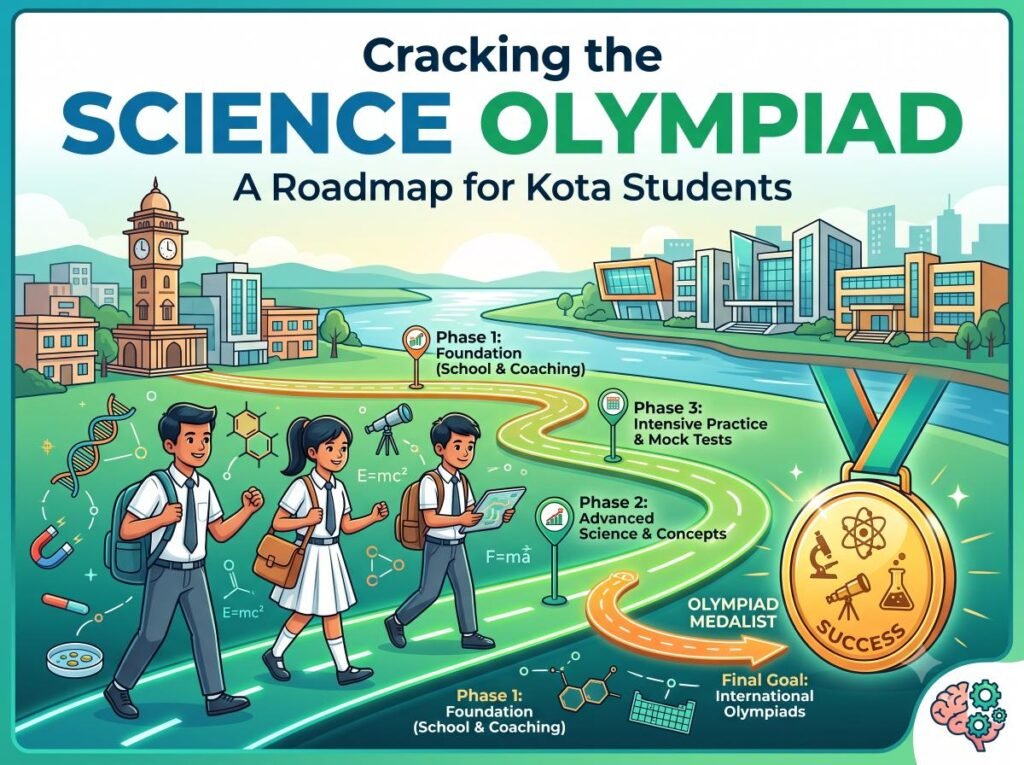
1. Decoding the Five Stages of the Science Olympiad
The Science Olympiad program in India is jointly organized by the Homi Bhabha Centre for Science Education (HBCSE) and various teacher associations (like the IAPT for Physics). The journey from your school classroom to the international stage is a brutal five-stage elimination process.
You must choose your specific battleground: Physics (NSEP), Chemistry (NSEC), Biology (NSEB), Astronomy (NSEA), or Junior Science (NSEJS for students in Classes 8 to 10).
| Stage | Examination Name | Format & Goal |
| Stage 1 | NSE (National Standard Examination) | Objective MCQ test. Filters ~50,000 students down to the top 300 per subject nationwide. |
| Stage 2 | INO (Indian National Olympiad) | Highly conceptual subjective paper. Selects the top 35-40 students per subject. |
| Stage 3 | OCSC (Orientation-cum-Selection Camp) | A rigorous 2-3 week camp at HBCSE focusing on both theory and advanced laboratory experiments. |
| Stage 4 | Pre-Departure Training Camp | Specialized training for the final team of 4-6 students selected to represent India. |
| Stage 5 | International Olympiad | The global competition against the best high school minds from over 80 countries. |
2. Why Olympiad Prep is the Ultimate JEE/NEET Hack
A common fear among parents and students is that preparing for the Science Olympiads will distract from JEE or NEET preparation. This is a massive misconception.
The syllabus for the senior Olympiads (NSEP, NSEC, NSEB) maps almost perfectly to the Class 11 and 12 CBSE curriculum, but tests it at a depth that eclipses the JEE Advanced.
-
Conceptual Immunity: An Olympiad problem requires you to derive solutions from first principles. If you can solve an INO-level physics problem involving rotational mechanics, the JEE Advanced questions on the same topic will feel like a warm-up exercise.
-
Zero “Trick” Dependency: Coaching centers often teach shortcuts and formulaic tricks. Olympiads actively design problems where standard tricks fail, forcing you to develop true analytical reasoning.
-
The Global Resume: While a good JEE rank secures a seat in an Indian engineering college, an Olympiad medal is a golden ticket to Ivy League universities (like MIT, Stanford, or Cambridge), often with full scholarships.
3. Subject-Specific Tactical Approaches
Preparing for a Science Olympiad requires a fundamental shift in how you consume textbooks. You cannot just read the theory; you must challenge it.
Physics (NSEP & INPhO)
Physics Olympiads are notorious for presenting real-world scenarios rather than sterile textbook diagrams.
-
The Strategy: You must master calculus-based physics early. Stop relying on derived formulas and learn how to set up differential equations for physical systems.
-
The Resources: Start with Concepts of Physics by H.C. Verma to build the base, but quickly move to Fundamentals of Physics by Resnick, Halliday, and Walker. For advanced INPhO prep, Problems in General Physics by I.E. Irodov is mandatory.
Chemistry (NSEC & INChO)
Chemistry Olympiads require a massive memory bank combined with sharp logical deduction, particularly in organic synthesis and physical chemistry thermodynamics.
-
The Strategy: Do not treat Physical, Organic, and Inorganic chemistry as separate subjects. Olympiad problems often blend them. For example, you might need to use thermodynamics to predict the feasibility of an organic reaction.
-
The Resources: Physical Chemistry by Peter Atkins, Organic Chemistry by Clayden, Greeves, and Warren (the ultimate authority), and Concise Inorganic Chemistry by J.D. Lee.
Biology (NSEB & INBO)
Forget rote memorization. The Biology Olympiad is heavily analytical, focusing on genetics, molecular biology, plant anatomy, and ecology. You will often be presented with data from a real scientific paper and asked to draw conclusions.
-
The Strategy: Learn to read graphs, pedigree charts, and experimental data. Focus heavily on understanding mechanisms (e.g., exactly how a specific enzyme catalyzes a reaction) rather than just memorizing names.
-
The Resources: The absolute bible for this exam is Campbell Biology. Read it cover to cover, and ensure you solve the conceptual questions at the end of every chapter.
Junior Science (NSEJS & INJSO)
Designed for younger students, this is the most competitive entry point. It requires an integrated understanding of Physics, Chemistry, and Biology up to the Class 11 level.
-
The Strategy: Do not rely on Class 9 and 10 textbooks; they are grossly insufficient. You must study the Class 11 NCERT textbooks for all three sciences thoroughly to stand a chance at clearing Stage 1.
4. The Practical Hurdle: Why Dummy Schools Fail Olympiad Aspirants
If you make it past Stage 2 (INO) and are invited to the Orientation-cum-Selection Camp (OCSC) in Mumbai, the game changes entirely. Stage 3 introduces rigorous, advanced laboratory experiments.
This is where the “dummy school” model—prevalent in Kota—spectacularly fails its brightest students. If a student has spent two years sitting in a coaching center and has never touched a burette, calibrated an oscilloscope, or stained a biological slide, they will be eliminated at the OCSC stage, regardless of their theoretical brilliance.
Experimental physics and chemistry require muscle memory, precision, and an intuitive understanding of error analysis. You cannot learn how to handle delicate laboratory equipment by watching a YouTube video.
5. The Vidhyanjali Academy Advantage
At Vidhyanjali Academy, we believe that true scientific talent requires a laboratory, not just a lecture hall. We specifically design our academic environment to support elite Olympiad aspirants who refuse to compromise on practical scientific training.
-
World-Class Laboratories: Our physics, chemistry, and biology labs are equipped beyond standard CBSE requirements, allowing advanced students to perform OCSC-level experiments and learn precise data analysis.
-
Dedicated Mentorship: Preparing for the Olympiads requires guidance that standard coaching modules do not provide. Our subject-expert faculty are available to discuss advanced texts, debate theoretical concepts, and guide students through complex problem-solving strategies.
-
The Peer Ecosystem: You are the average of the five people you spend the most time with. Our campus brings together a concentrated pool of highly ambitious, intellectually curious students, creating a collaborative environment where discussing a complex calculus problem is a normal lunch-break activity.
The path to an International Science Olympiad medal is incredibly steep, but the intellectual transformation you undergo while climbing that mountain is unparalleled. Build your theoretical base, demand access to practical laboratories, and start your preparation today.