


Why Design Thinking is the Missing Link in Kota’s Education System
In Kota, the definition of academic success is often extremely narrow: securing a top rank in a hyper-competitive entrance exam. For years, the educational ecosystem has been fine-tuned to produce students who are exceptionally fast at applying formulas, solving multiple-choice questions, and memorizing vast amounts of data.
But what happens the day after the exam?
When a student enters an IIT, an AIIMS, or steps into the modern workforce, the rules change entirely. Real-world problems do not come with four multiple-choice options. Engineering a sustainable bridge, designing a new medical device, or writing an AI algorithm requires a completely different cognitive toolkit. It requires creativity, empathy, and the ability to navigate ambiguity.
This is where Design Thinking comes in. Moving beyond rote memorization, introducing Design Thinking into the school curriculum is how we transform test-takers into true innovators.
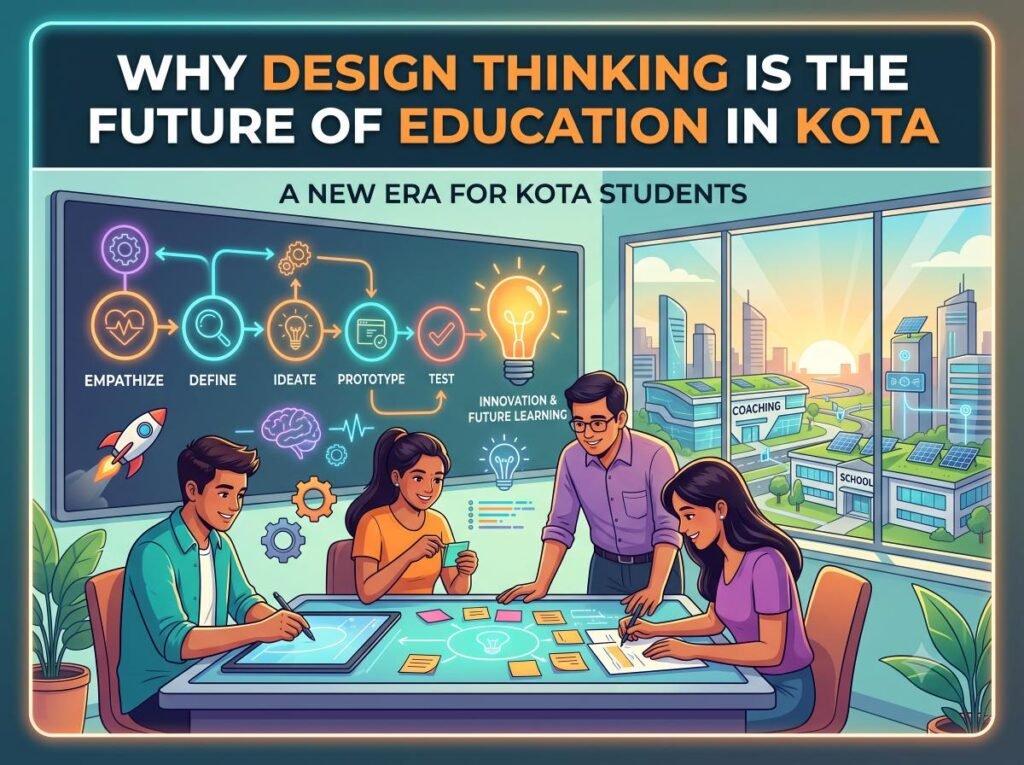
What Exactly is Design Thinking?
Design Thinking is not a subject; it is a problem-solving framework used by top universities and tech companies worldwide. It is a non-linear, iterative process that seeks to understand users, challenge assumptions, and redefine problems to identify alternative solutions.
The framework is broken down into five core phases:
-
Empathize: Researching and understanding the needs of the people you are designing a solution for.
-
Define: Stating your users’ needs and problems clearly.
-
Ideate: Challenging assumptions and brainstorming a massive volume of creative solutions.
-
Prototype: Starting to create physical or digital solutions to test your ideas.
-
Test: Trying your solutions out in the real world and learning from what fails.
When applied to school education, it flips the traditional classroom model upside down. Instead of a teacher giving students a problem and the single “correct” answer, the teacher gives the students a real-world scenario and asks them to design a solution from scratch.
How Design Thinking Complements JEE and NEET Prep
Many parents worry that adding “creative” frameworks to a student’s plate will distract them from their core entrance exam preparation. In reality, Design Thinking acts as a massive cognitive amplifier for science students.
Here is how the two approaches differ, and why students need both:
| Feature | Traditional Exam Prep | Design Thinking Approach |
| The Goal | Finding the single correct answer quickly. | Finding multiple viable solutions to a complex problem. |
| The Mindset | Convergent thinking (narrowing down options). | Divergent thinking (expanding possibilities). |
| Failure | Viewed as a negative outcome (losing marks). | Viewed as valuable data (learning what doesn’t work). |
| Collaboration | Solitary and highly competitive. | Highly collaborative and team-oriented. |
When a student learns to think like a designer, they stop panicking when they encounter a JEE Advanced question they have never seen before. Instead of giving up because they don’t know the “trick,” they use logical deduction, test different assumptions (prototyping), and iterate their way to the solution.
Building Emotional Resilience Through “Failing Forward”
The most profound benefit of Design Thinking in a high-pressure city like Kota is psychological.
In the traditional coaching system, failure is heavily penalized. A bad mock test score often leads to severe anxiety and a drop in confidence. Design Thinking, however, normalizes failure. In the “Prototype and Test” phases, the explicit goal is to figure out where your idea breaks.
When a student builds a robotic arm in the lab and the motor burns out, it isn’t a failure—it is a data point. This teaches students a concept called “failing forward.” By removing the stigma of being wrong, students develop immense emotional resilience. They learn that their self-worth is not tied to a perfect score, but to their ability to adapt and overcome a challenge.
Bringing It to Life: The Vidhyanjali Academy Approach
At Vidhyanjali Academy, we refuse to let our students be one-dimensional. We integrate the principles of Design Thinking across our curriculum to ensure our students are ready for the future, not just the next test.
-
Project-Based Learning (PBL): Instead of just reading about renewable energy in a physics textbook, our students are tasked with designing workable wind turbine models using limited resources. They have to empathize with energy-scarce communities, prototype their models, and test their voltage output.
-
Coding and Logic Labs: Programming is the ultimate exercise in Design Thinking. Our computer science curriculum focuses heavily on debugging—teaching students that writing code is 20% typing and 80% figuring out why it isn’t working and iterating on the solution.
-
Open-Ended Assessments: We incorporate questions in our internal assessments that have no single right answer, forcing students to justify their unique logical approaches and communicate their ideas clearly.
An education that only prepares a child for an entrance exam is an incomplete education. By embedding Design Thinking into our daily routine, we ensure that when our students finally reach their dream colleges, they aren’t just there to take notes—they are there to lead, invent, and build the future.