


The Secret System: Habits and Daily Routine of Topper Students in Kota
Walk into any coaching center in Kota, point to the student consistently scoring in the top ten, and ask the rest of the class what their secret is. You will almost always hear the same myths: “They study 18 hours a day,” “They never sleep,” or “They are just naturally gifted.”
As educators who have observed thousands of students navigate the grueling journey toward the IIT-JEE and NEET, we can tell you with absolute certainty that these myths are false.
The students who secure top All India Ranks (AIR) do not have magical brains. They have magical systems. Success in highly competitive exams is not about studying to the point of exhaustion; it is about extreme efficiency, emotional regulation, and ruthless consistency.
If you want to perform like a topper, you have to adopt their systems. Here is a breakdown of the real habits and the sustainable daily routine that separates the top 1% from the rest of the pack.
Habit 1: Prioritizing the “Sleep-Memory” Cycle
The most destructive lie in the Kota ecosystem is that sleeping is a waste of time. Average students cut their sleep down to four hours, relying on caffeine to stay awake. They read the same page five times because their brain is too exhausted to process the information.
Toppers treat sleep as a non-negotiable study tool.
-
The Science: During deep REM sleep, the brain physically consolidates the information learned during the day, transferring formulas and concepts from short-term to long-term memory.
-
The Habit: Toppers maintain a strict 7 to 8-hour sleep schedule. They go to bed at the exact same time every night to maintain their circadian rhythm, ensuring their brain is fully alert during the actual exam hours (usually 9:00 AM to 12:00 PM).
Habit 2: Active Recall vs. Passive Reading
If you ask an average student how they study, they will say, “I read the NCERT chapter, highlighted the important parts, and watched a lecture.” This is passive learning. It creates an illusion of competence—you feel like you know the material because it looks familiar on the page.
Toppers rely almost entirely on Active Recall.
-
Testing Over Reading: Instead of re-reading a chapter on Thermodynamics, a topper will close the book, take a blank sheet of paper, and attempt to write down every formula and derivation from memory.
-
Feynman Technique: They explain complex concepts out loud (either to a peer or to an empty room) in simple terms. If they stumble on an explanation, they know exactly where their conceptual gap lies.
-
Error Logs: Toppers do not just check their mock test scores; they maintain a meticulous “Mistake Notebook.” They write down exactly why they got a question wrong (calculation error, concept error, or misread question) and review this log before the next test.
Habit 3: Designing a Sustainable Timetable (The “Slot” System)
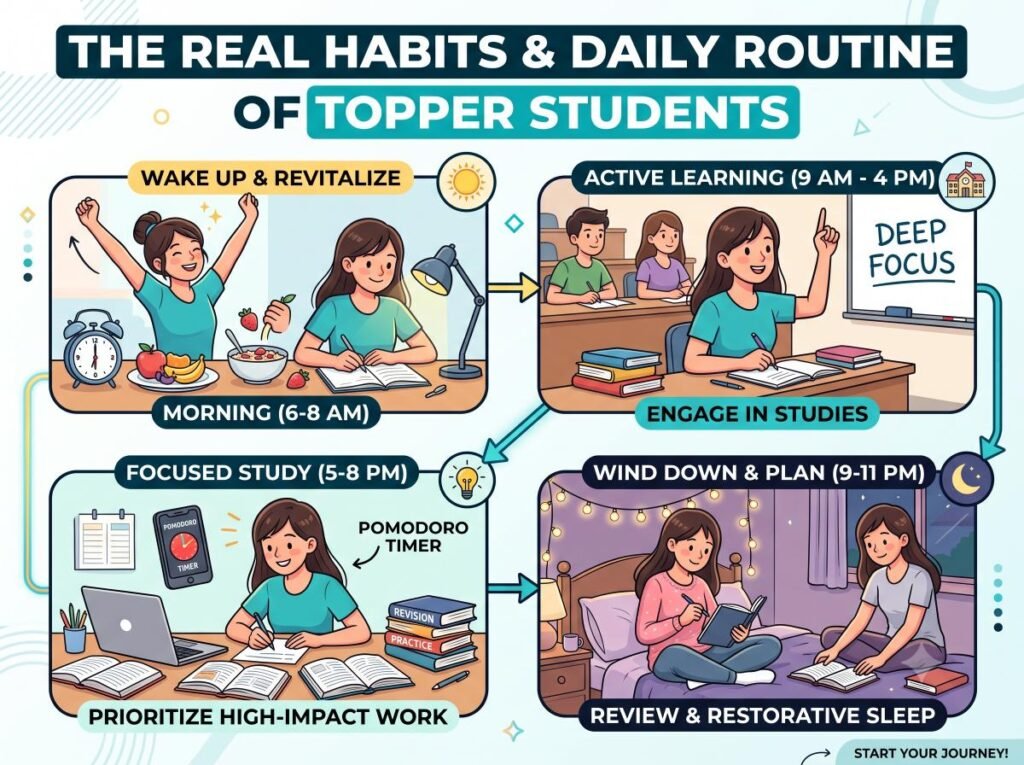
A topper does not sit at a desk for six uninterrupted hours. They understand that cognitive focus plummets after 90 minutes. Instead of a monolithic study block, they organize their day into highly focused, unbreakable “slots.”
Here is a comparison of how time is managed differently:
| Time of Day | The “Burnout” Routine (Average Student) | The “Topper” Routine (Sustainable System) |
| Morning (6:30 AM) | Wakes up exhausted, skips breakfast to study. | Wakes up, exercises for 20 mins, eats a heavy breakfast. |
| School/Coaching | Passively listens, chats in the back row. | Highly engaged, clears doubts immediately, takes active notes. |
| Afternoon (3:00 PM) | Takes a 3-hour nap to recover from sleep debt. | 30-minute power nap, followed by a 90-minute study slot (Active Recall). |
| Evening (6:00 PM) | Studies for 5 hours straight with phone on desk. | 1-hour physical sports/recreation, followed by two 90-minute study slots. |
| Late Night (11:30 PM) | Panic-studying until 2:00 AM. | Plans tomorrow’s agenda in 10 minutes, sleeps by midnight. |
Habit 4: Ruthless Distraction Management
Toppers are not immune to the lure of Instagram, YouTube, or video games. They just build physical barriers to prevent those distractions from ruining their study slots.
-
The “Phone in Another Room” Rule: During a 90-minute study slot, the smartphone is physically out of reach, often in another room or handed over to a parent/warden.
-
No Digital Multitasking: If they are watching a video lecture, they are not simultaneously checking WhatsApp on a split screen. They treat the digital lecture with the exact same respect as a live physical classroom.
Habit 5: Leveraging the School Ecosystem
One of the biggest differentiators is how top students view their regular school. While many students see school as a burden that takes time away from coaching, smart students leverage it as a strategic advantage.
At a progressive institution like Vidhyanjali Academy, toppers use the school environment to master their foundation.
-
Board Preparation on Autopilot: By paying attention in their regular CBSE classes, toppers finish their board exam preparation concurrently. They do not have to panic in January because they already mastered the NCERT subjective answers during school hours.
-
Using Free Periods Strategically: Instead of wasting time, top students use library periods to complete their coaching DPPs (Daily Practice Problems) in a quiet, supervised environment.
-
Decompression through Sports: Toppers utilize our mandatory physical education periods. They understand that sweating on the basketball court or football field burns off cortisol (stress hormone) and resets their brain for the evening study session.
The Myth of Motivation
Perhaps the most important habit of a topper is that they do not rely on motivation. Motivation is a feeling, and feelings are fickle. You will not feel motivated to study rotational mechanics on a cold Tuesday morning when you are tired.
Toppers rely on discipline and routine. They study because the schedule dictates it, not because they feel like it. By building a sustainable daily routine, prioritizing their physical health, and treating their education as a strategic system, they remove the friction from success.
You do not need to be a genius to top an exam. You just need to build a better system today than you had yesterday.