


Nursery Admission Guide 2026: Everything Parents Need to Know
Meta Description: Preparing for nursery admissions in 2026? Read our complete guide covering age criteria, essential documents, application timelines, and tips for choosing the right preschool for your child.
For parents, few milestones feel as daunting—or as exciting—as a child’s first day of school. However, before you can pack that tiny backpack, you have to navigate the nursery admission process.
If you are targeting the 2026-2027 academic session, the time to start preparing is now. With shifting educational guidelines and highly competitive application pools in top schools, staying ahead of the curve is essential.
Here is your complete, step-by-step nursery admission guide for 2026 to ensure a smooth, stress-free experience for you and your little one.
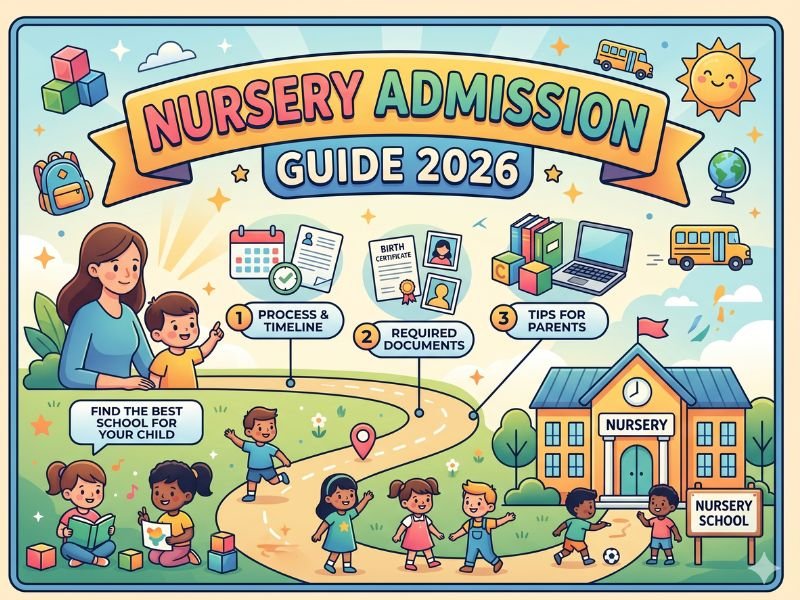
1. Understand the Age Criteria (NEP 2020 Guidelines)
The most critical factor in nursery admissions is your child’s age. With the implementation of the National Education Policy (NEP) 2020 across India, age criteria have become stricter and more uniform.
-
The Golden Rule: For admission into Nursery (sometimes called Balvatika 1 or Pre-K), a child must generally be 3 years old by March 31st, 2026.
-
The Cut-off Window: This means your child should ideally be born between April 1, 2022, and March 31, 2023.
-
Note: Always verify the exact cut-off date with your state’s education department or the specific school, as minor variations can sometimes occur.
2. The 2026 Admission Timeline
Do not wait until 2026 to start looking for schools! The admission cycle begins much earlier than the academic year. Here is a typical timeline to keep you on track:
-
August – September 2025 (Research Phase): Begin shortlisting schools. Attend school tours, check reviews, and talk to other parents.
-
October – November 2025 (Form Distribution): Most top-tier schools release their admission forms (both online and offline) during these months.
-
December 2025 (Submission & Interactions): Deadline for form submissions. Schools will begin scheduling parent-child interaction sessions.
-
January – February 2026 (Results): The first and second lists of selected students are typically released.
-
April 2026 (Session Begins): Welcome to Nursery!
3. How to Choose the Right Preschool
When evaluating schools for a three-year-old, the criteria are vastly different than choosing a high school. Keep these three “P’s” in mind:
Proximity
Young children should not spend hours on a school bus. Look for schools within a 3 to 5-kilometer radius of your home. A short commute keeps the child energetic and makes it easier for you to reach the school in case of an emergency.
Pedagogy (Teaching Style)
Different schools use different early childhood philosophies.
-
Playway: Focuses entirely on learning through unstructured and structured play.
-
Montessori: Encourages child-led learning using specific, hands-on physical materials.
-
Reggio Emilia: A project-based approach where the environment is viewed as the “third teacher.” Choose a methodology that matches your child’s natural temperament.
Peer Environment and Safety
Visit the campus during school hours if possible. Are the classrooms bright and child-proofed? What is the student-to-teacher ratio? (Ideally, it should not exceed 15:1 for nursery). Are the washrooms clean and easily accessible?
4. The Essential Document Checklist
Nothing derails an admission application faster than missing paperwork. Create a dedicated folder by mid-2025 with both physical and scanned copies of the following documents:
-
Birth Certificate: Issued by the Municipal Corporation (Name and spelling must perfectly match all other documents).
-
Address Proof: Passport, Aadhar Card, Voter ID, or a recent utility bill (Electricity/Water) in the parents’ name.
-
Photographs: Recent passport-sized photographs of the child, mother, and father (and sometimes a family photograph).
-
Medical Fitness Certificate: A certificate from your pediatrician stating the child’s blood group, vaccination record, and any specific allergies.
-
Parent Identity Proof: Aadhar Card or PAN card of both parents.
-
Optional but helpful: Sibling proof (if an older sibling already studies in the same school) or Alumni proof (if a parent graduated from the school), as these often carry extra points.
5. Preparing for the “Interaction” Round
Under Indian law, schools are not allowed to conduct formal interviews or written tests for toddlers. Instead, they hold “interactions” to assess the child’s basic developmental milestones and understand the parents’ educational views.
-
For the Child: Do not force them to memorize the alphabet or complex poems. Schools are simply looking to see if the child can follow basic instructions, recognize primary colors or shapes, and separate from their parents without severe distress.
-
For the Parents: Be authentic. Schools want to know if your parenting style aligns with their educational philosophy. Be prepared to answer questions about your child’s eating habits, screen time routines, and how you handle temper tantrums.
Conclusion: Keep Calm and Apply On
The nursery admission process can feel like a marathon, but staying organized is your best defense against the stress. Shortlist a mix of “dream” schools and practical backup options.
Remember, at the end of the day, a preschool is just the very first step in a long educational journey. Trust your instincts, choose a school where your child feels safe and happy, and the rest will fall into place!