


Safety First: What Parents Must Look for When Choosing a School in Kota
Sending a teenager away from home to prepare for the most competitive exams in the country is one of the most difficult decisions a parent can make. As families pack bags and book train tickets to Kota, their minds are often flooded with a mix of immense pride and deep anxiety. While the student is focused on clearing the IIT-JEE or NEET, the parents are consumed by a different set of primary concerns: Will my child be safe? Who will look out for them? What happens if there is an emergency?
In a city that hosts over a hundred thousand migrating students every year, the ecosystem is heavily geared toward academic coaching. However, academics alone cannot sustain a child. A student cannot focus on complex physics derivations or biological diagrams if they do not feel physically and emotionally secure in their environment. This is why choosing the right school is not just an academic decision—it is a critical safety measure.
Recent initiatives by the district administration, such as the “Kota Cares” campaign, have heavily emphasized the need for standardized safety protocols across student housing and educational institutions. But as a parent, you need to know exactly what to look for when evaluating an institution.
Here is a comprehensive, deep-dive guide into the critical safety and security protocols you must demand when searching for safe schools in Kota.
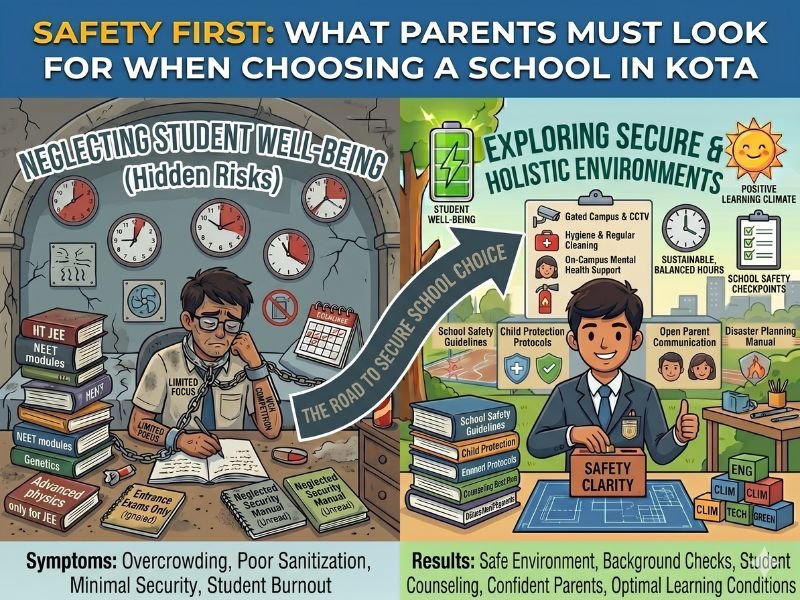
1. The Kota Ecosystem: Why School is the First Line of Defense
Kota is a bustling hub of intellectual energy, but it is also a city where teenagers are suddenly thrust into an adult level of independence. For many students, this is their first time managing their own schedules, finances, diet, and transportation. In a standard “dummy school” setup, a student’s daily life is split between crowded coaching centers and isolated PG rooms, with very little structured oversight in between.
A regular school acts as the essential anchor in a student’s chaotic life. It is the one place where they are not just an enrollment number or an All India Rank, but an individual. A school’s administration, teachers, and support staff become the local guardians who see your child every single day. Therefore, the school’s infrastructure and policies must be designed to protect them from the moment they step out of their home or hostel until they return safely.
When evaluating a school, parents must look beyond the glossy brochures detailing past academic results. You must ask hard questions about infrastructure, emergency protocols, staff training, and the daily tracking of student whereabouts.
2. Physical Campus Security: Fortifying the Environment
The foundation of any safe educational institution is its physical infrastructure. Campus security Kota style requires a multi-layered approach to prevent unauthorized entry and monitor internal activities.
Here is a checklist of physical security features a top-tier school must have:
A. Controlled Access and Perimeter Security
The campus must be a closed, secure environment.
-
Boundary Walls and Fencing: The school should have high boundary walls, ideally topped with anti-scale fencing, to prevent trespassing.
-
Single Point of Entry: During school hours, there should only be one operational entry and exit point for students and visitors. This allows security personnel to screen everyone who walks through the gates.
-
Visitor Management System: No outsider—whether a vendor, a delivery person, or even a relative—should be allowed past the reception without logging their details, surrendering an ID, and receiving a visitor badge.
B. Comprehensive Surveillance Systems
While human guards are essential, technology provides an unblinking eye.
-
CCTV Coverage: High-definition CCTV cameras must cover all strategic points of the school. This includes the main gates, corridors, staircases, cafeteria, library, playgrounds, and the perimeter of the washrooms.
-
Active Monitoring: Cameras are useless if the footage is only checked after an incident occurs. The school should have a dedicated control room where security staff actively monitors the feeds during school hours.
-
Data Retention: Ensure the school has a policy of retaining CCTV footage for a minimum of 30 to 45 days.
C. Attendance Tracking and Truancy Prevention
In Kota, skipping class is a common symptom of academic stress or negative peer influence.
-
Biometric or RFID Attendance: The moment a student enters the school gate, their attendance should be electronically logged.
-
Automated SMS Alerts: Parents should receive an automated SMS notification if their child has not swiped into the school by the designated start time. This ensures that parents in other cities know exactly when their child has reached school safely.
D. Disaster Management and Structural Safety
Natural disasters or fires do not give warnings.
-
Fire Safety Compliance: The building must have a valid NOC (No Objection Certificate) from the fire department. Look for visible fire extinguishers, functional smoke detectors, and clear evacuation maps in every hallway.
-
Mock Drills: The school should conduct regular fire and earthquake evacuation drills so students develop muscle memory on how to exit the building calmly and safely.
3. The Commute: Prioritizing Kota School Transport
The journey between the hostel and the school is often the most vulnerable part of a student’s day. Navigating the busy streets of Kota requires a reliable, secure transportation system. Relying on irregular public transport or shared auto-rickshaws introduces unnecessary risks.
A premium school must offer its own fleet of buses governed by strict safety regulations. When assessing Kota school transport, look for the following non-negotiable features:
| Transport Safety Feature | Why It Is Crucial |
| GPS Tracking Apps | Allows parents and the school administration to track the exact real-time location of the bus, ensuring it does not deviate from the approved route. |
| CCTV Inside Buses | Deters bullying and inappropriate behavior during the commute, ensuring student discipline while the driver focuses on the road. |
| Female Attendants | Mandatory for any bus carrying female students. The attendant ensures students board and deboard safely and maintains order. |
| Speed Governors | Electronic devices installed in the engine to physically prevent the bus from exceeding a safe speed limit (usually 40-50 km/h) within city limits. |
| Strict Background Checks | Drivers and conductors must undergo rigorous police verification, background checks, and regular breathalyzer tests to ensure absolute sobriety. |
A school that takes ownership of the daily commute demonstrates that its responsibility extends beyond its physical boundary walls.
4. A Special Focus: Female Student Safety in Kota
While safety is paramount for all teenagers, the concerns are naturally amplified for families sending their daughters to study in a new city. Ensuring female student safety Kota is a complex responsibility that requires proactive, highly specific policies. A school must be a sanctuary where female students feel entirely respected, comfortable, and protected.
Infrastructure for Privacy and Hygiene
-
Segregated, Monitored Zones: Washrooms and locker rooms must be strictly segregated, heavily monitored at the entrances by female staff, and equipped with sanitary pad dispensers and proper disposal incinerators.
-
Female Security Personnel: A significant portion of the school’s security staff, especially those patrolling the corridors and managing the girls’ common areas, must be female.
Empowerment and Self-Defense
True safety isn’t just about building walls; it is about empowering the students themselves.
-
Self-Defense Workshops: Progressive schools integrate basic self-defense training into their physical education curriculum. Teaching girls situational awareness and physical defense techniques builds immense self-confidence.
-
Zero-Tolerance Harassment Policies: The school must have a clearly defined, zero-tolerance policy against any form of sexual harassment, eve-teasing, or inappropriate behavior. There must be an anonymous reporting mechanism so girls can report uncomfortable situations without fear of retaliation or public exposure.
-
Internal Complaints Committee (ICC): Mandated by law, a functional ICC must be in place to swiftly and strictly address any grievances related to student or staff misconduct.
When a school creates an environment where female students feel heard and fiercely protected, it directly translates into better focus and higher academic performance.
5. The Invisible Shield: Emotional and Mental Safety
Physical security is visible—you can see the cameras and the guards. But the most insidious dangers in Kota are often invisible: extreme stress, exam anxiety, peer pressure, and the crushing weight of expectations.
In recent years, the administration’s “Kota Cares” initiative has mandated that hostels and coaching centers take mental health seriously. A modern school must lead this charge. Emotional safety is just as critical as physical safety.
Recognizing the Signs of Distress
Teenagers rarely walk up to an adult and say, “I am severely depressed.” They show it through behavioral changes: dropping grades, sudden isolation, chronic absenteeism, or extreme irritability.
-
Gatekeeper Training: The best schools train their entire staff—not just teachers, but also bus drivers, cafeteria workers, and security guards—in basic “gatekeeper” protocols. This means training adults to recognize the early warning signs of emotional distress and report them to the school counselor.
Dedicated Counseling and Psychological Support
A school in Kota cannot function properly without a dedicated, licensed student counselor on campus.
-
Confidential Safe Spaces: Students must have access to a counselor in a private, stigma-free environment. The counseling should be strictly confidential (unless there is a risk of self-harm), giving students a safe outlet to vent their anxieties before they escalate into clinical depression.
-
Peer Support Systems: Establishing student-led mental health clubs or “buddy systems” helps new students integrate faster. Often, a student is more likely to open up to a peer than to an authority figure.
Anti-Bullying and Cyber-Safety Protocols
Bullying in the modern age rarely happens in the schoolyard; it happens on WhatsApp groups and Instagram.
-
Cyber-Bullying Education: Schools must conduct regular workshops teaching students about digital footprints, the legal consequences of cyber-bullying, and how to protect their online privacy.
-
Strict Disciplinary Action: A transparent anti-bullying policy must be enforced, ensuring that the school remains a collaborative, supportive space rather than a toxic, hyper-competitive one.
6. The Day Boarding Advantage: A Controlled, Holistic Environment
When searching for the perfect balance of intense academic preparation and comprehensive safety, many parents are turning away from the fragmented “Dummy School + Coaching + PG” model and opting for the best day boarding school Kota has to offer.
What is a Day Boarding Setup?
In a day boarding school, a student arrives in the morning and stays until the late afternoon or early evening. The school provides regular classes, coaching for competitive exams, dedicated self-study periods in the library, and sports activities—all under one roof. The student is provided with highly nutritious meals in the school cafeteria throughout the day.
Why Day Boarding is the Safest Option
From a safety perspective, the day boarding model is practically unbeatable:
-
Eliminates Idle Time: Unstructured free time in a PG is often when teenagers develop bad habits, alter their sleep schedules, or spiral into anxiety. Day boarding keeps them engaged in productive, supervised activities for the majority of their waking hours.
-
Reduces Commute Risks: Instead of traveling back and forth between a school, a coaching center, and a hostel multiple times a day, the student makes only one round trip.
-
Nutritional Monitoring: Parents do not have to worry if their child is skipping meals to study. The school ensures the student eats balanced, hygienic meals at fixed times.
-
Continuous Supervision: The student remains under the watchful eye of trained educators and security personnel for 8 to 10 hours a day. If a student is unwell or unusually quiet, the school staff will notice immediately and intervene.
Choosing a day boarding school essentially outsources the logistical and safety concerns to professionals, allowing the student to focus entirely on their studies, and allowing the parents to finally sleep peacefully at night.
The Ultimate Partnership
Education in Kota is a high-stakes journey, but it should never be a dangerous one. Choosing a school is about finding a partner you can trust with your child’s life, not just their academic transcripts.
When you tour a prospective school, look past the laboratories and the smart boards. Ask to see the CCTV control room. Ask about the background checks of the bus drivers. Ask to meet the school counselor. A school that is truly confident in its safety protocols will proudly walk you through every single measure they have implemented.
Your child’s peace of mind—and your own—is the ultimate prerequisite for success. Choose a school that fiercely protects both.