


Ultimate 2026 School Admission Guide for Kota: Navigating the Coaching Capital
Kota is not just a city; for thousands of students across India, it is the launchpad for engineering (JEE) and medical (NEET) dreams. Because the city’s educational ecosystem revolves heavily around competitive coaching, school admissions here operate a bit differently than in the rest of the country.
Whether you are relocating your family to Kota or sending your child to live in a hostel for Class 11, finding the right school is critical to balancing their board exams with their coaching prep.
If you are looking to secure a seat for the 2026-2027 academic year, here is your detailed, step-by-step guide to navigating school admissions in Kota.
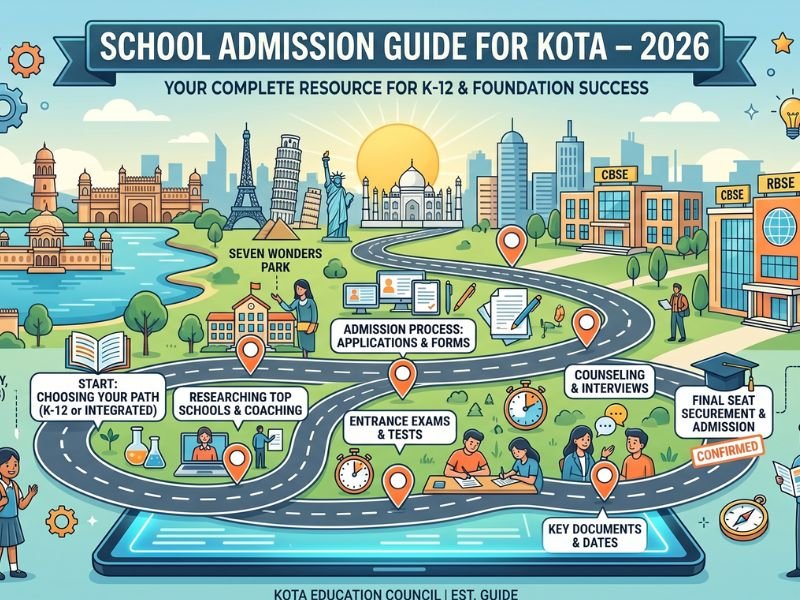
1. Understand the Kota Schooling Models
Before looking at specific schools, you must decide which type of schooling model fits your child’s coaching schedule. Kota generally offers three paths:
-
Regular Schools: These are traditional schools where attendance is strictly monitored, and students participate in daily classes, sports, and extracurriculars.
-
Best for: Younger students (Classes 6-9) or Class 11/12 students who are not enrolled in intensive, full-time day coaching.
-
-
Integrated Schools (Tie-ups): Many top coaching institutes have official tie-ups with specific schools. The school curriculum and coaching classes are merged, usually on the same campus, to save the student travel time and reduce redundant studying.
-
Best for: Students who want a highly structured day without the hassle of commuting between school and coaching.
-
-
“Coaching-Friendly” (Non-Attending) Schools: Colloquially known as “dummy schools,” these institutions have highly relaxed attendance policies. Students are only required to show up for practicals and board exams, leaving their entire day free for coaching and self-study.
-
Best for: Hardcore JEE/NEET aspirants in Classes 11 and 12 who need maximum time for competitive prep. (Note: Always verify the CBSE/RBSE affiliation and legal standing of these schools before enrolling).
-
2. Choosing the Right Board
The choice of board in Kota is heavily influenced by the entrance exam the student is targeting.
-
CBSE (Central Board of Secondary Education): This is the undisputed favorite in Kota. The CBSE syllabus is directly aligned with the NCERT textbooks, which are the foundational materials for both JEE and NEET. Over 80% of coaching students opt for CBSE.
-
RBSE (Rajasthan Board of Secondary Education): A popular choice for local residents or those who prefer a state-level curriculum. It is a solid backup, but students will need to ensure they separately cover the NCERT syllabus for national entrance exams.
3. The 2026 Admission Timeline
While standard school admissions in India begin in November/December of the previous year, Kota operates on a slightly extended timeline to accommodate the influx of students arriving for coaching.
-
Early Admissions (Classes LKG to 9): Usually conducted between December 2025 and March 2026.
-
Class 11 Admissions (Peak Season): Because Class 11 admissions depend on Class 10 board results, the peak admission season in Kota happens right now—in May and June 2026. Many schools offer provisional admission starting in April, which is confirmed once board results are declared.
-
Late Admissions / Transfers: Due to the transient nature of Kota’s student population, many coaching-friendly schools accept late transfers all the way through July and August 2026.
4. Step-by-Step Admission Process
The process for securing a seat is relatively straightforward, especially for integrated and coaching-friendly schools.
Step 1: Finalize the Coaching Institute First
If your child is in Class 11 or 12, choose the coaching institute (Allen, Resonance, Motion, PW, etc.) before choosing the school. The institute will often provide a list of recommended or tied-up schools that align with their batch timings.
Step 2: Location and Logistics
If opting for a regular school, choose one that is close to the student’s hostel or coaching center. Traffic in prime coaching areas like Rajiv Gandhi Nagar, Talwandi, or Jawahar Nagar can be heavy, and saving commute time is vital.
Step 3: Application and Assessment
-
For Regular Schools: Fill out the online/offline admission form. Top-tier traditional schools may require an entrance test (covering basic Math, Science, and English) and a brief interaction with the principal.
-
For Coaching-Friendly Schools: Admissions are usually direct, based on previous class mark sheets.
Step 4: Fee Payment and Confirmation
Once approved, you will need to pay the admission fee and the first-quarter tuition fee to secure the seat.
5. Essential Document Checklist for 2026
Ensure you have a dedicated folder with multiple physical and digital copies of the following documents. Missing paperwork is the number one cause of admission delays.
-
Transfer Certificate (TC): Original TC from the previous school, signed by the principal. (If transferring from another state, it may need to be countersigned by the local education officer).
-
Migration Certificate: Mandatory for students changing their educational board (e.g., moving from ICSE or a State Board to CBSE for Class 11).
-
Mark Sheets: Photocopies of the previous year’s final report card. For Class 11 admissions, the Class 10 board exam mark sheet is required.
-
Aadhar Card: Copies of the student’s Aadhar card (and sometimes the parents’ Aadhar cards) for identity and age proof.
-
Passport Size Photographs: Keep at least 8-10 recent photographs of the student, plus 2-3 of the parents.
-
Medical Certificate: A basic fitness certificate from a registered medical practitioner (often required by regular schools).
Final Word of Advice
Kota is a high-pressure environment. While choosing the right school and board is important for academic logistics, the most crucial factor for success in 2026 is ensuring your child has a supportive environment. Prioritize schools and accommodations that offer a safe, encouraging atmosphere to help them manage the stress of their competitive journey.