


Sending your little one off to preschool is a major milestone—and often, an emotional one for parents! It is natural to wonder exactly what happens in those brightly colored classrooms. While it might look like they are just playing with blocks and finger-painting all day, preschool is actually a dynamic environment where foundational learning happens.
Play is the work of a child, and through it, they are building the critical building blocks for their future academic and personal success. So, what exactly are they taking away from this experience?
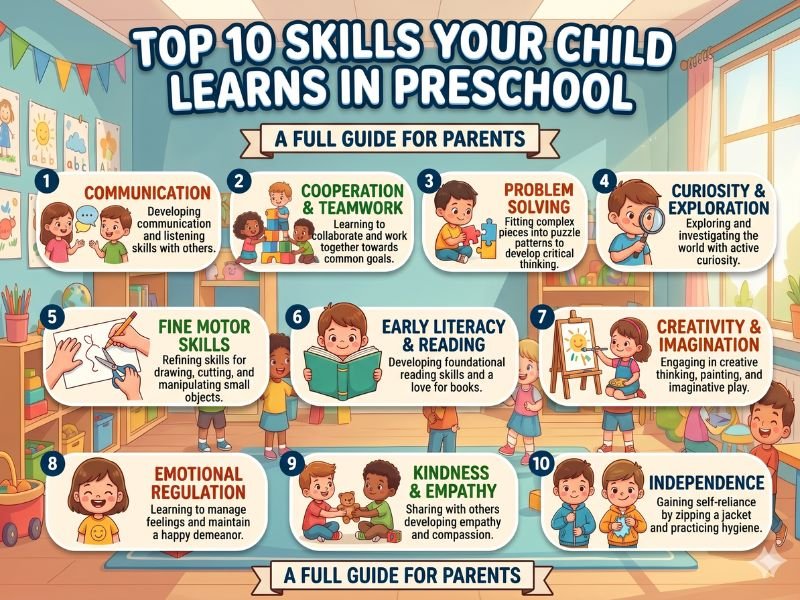
Here are the top 10 skills your child learns in preschool that will set them up for a lifetime of learning.
Social and Emotional Skills
Before children can master academics, they need to understand themselves and how to interact with others. Preschool is often a child’s first real experience navigating a community outside their family.
1. Socialization and Sharing
In a preschool setting, children learn how to exist in a group. They practice taking turns, sharing toys, and collaborating on small tasks. This environment teaches them the vital concept of compromise and helps them build their first independent friendships.
2. Emotional Regulation
Toddlers are famous for their big feelings. Preschool provides a safe space for children to experience these emotions and learn how to manage them. Teachers help children identify what they are feeling (e.g., “I see you are frustrated because the block fell”) and teach them healthy coping mechanisms, like taking deep breaths or using their words instead of their hands.
3. Empathy and Compassion
By being around peers from diverse backgrounds and with different personalities, children naturally develop empathy. They learn to notice when a friend is sad, offer comfort, and understand that other people have feelings and perspectives different from their own.
Cognitive and Academic Foundations
Preschool isn’t about rote memorization; it’s about introducing concepts in a way that sparks curiosity and a love for learning.
4. Language and Vocabulary Development
Between the ages of three and five, a child’s vocabulary explodes. Preschool teachers facilitate this through read-alouds, sing-alongs, and guided conversations. Children learn how to structure sentences, ask inquisitive questions, and express their thoughts clearly.
5. Basic Math and Number Sense
Long before they learn to add and subtract on paper, preschoolers are learning “number sense.” Through activities like sorting shapes, counting snacks, or building block towers, they grasp concepts like sequence, categorization, patterns, and spatial awareness.
6. Problem-Solving and Critical Thinking
When a child tries to build a bridge out of blocks and it keeps collapsing, they are faced with a problem. Preschool encourages them to test different solutions. What if we use a wider block at the base? This trial-and-error process is the very foundation of scientific thinking and resilience.
Physical Development
A child’s physical development is closely tied to their cognitive growth. Preschool classrooms are designed to get kids moving and refining their coordination.
7. Fine Motor Skills
Activities that seem like pure crafts—such as holding a crayon, using safety scissors, threading beads, or molding playdough—are actually crucial workouts for tiny hands. Developing these fine motor skills is a necessary prerequisite for learning how to write comfortably in kindergarten.
8. Gross Motor Skills
Running, jumping, climbing, and skipping during outdoor recess or gym time are essential for developing large muscle groups. These activities improve balance, hand-eye coordination, and overall physical confidence.
Independence and Life Skills
Perhaps one of the most noticeable changes parents see in their preschoolers is a sudden surge in independence.
9. Following Directions and Routines
Preschool classrooms thrive on predictability. Children learn to follow multi-step instructions (e.g., “Wash your hands, then find your seat for a snack”) and adapt to daily routines. Understanding how to transition smoothly from one activity to the next is a massive step in their cognitive development.
10. Self-Reliance and Personal Care
“I can do it myself!” Preschool nurtures this budding independence. Children learn to manage their personal belongings, put on their own coats, pack away their toys, and manage their bathroom needs independently. This self-reliance builds immense self-esteem and confidence.
Conclusion: The Power of Play
When looking at the skills your child learns in preschool, it becomes clear that early childhood education is about so much more than learning the alphabet. It is a holistic approach to child development.
By providing a structured, nurturing, and play-based environment, preschool equips children with the social grace, emotional resilience, physical coordination, and cognitive curiosity they need to thrive in kindergarten and beyond.