


What is a Nature School? The Ultimate Guide for Parents
Are you looking for an early education program that swaps indoor desks for tree stumps, and whiteboards for the great outdoors? If so, you might be looking for a Nature School.
Also known as “forest schools” or “outdoor kindergartens,” this educational movement has exploded in popularity in recent years. As parents increasingly worry about screen time and high-pressure academics for young children, nature schools offer a refreshing, mud-splattered alternative.
But what exactly happens when you remove the classroom walls? Is it just glorified playtime, or is real learning taking place?
In this comprehensive guide, we will break down exactly what a nature school is, the core philosophy behind it, and why so many parents are choosing the forest over the classroom.
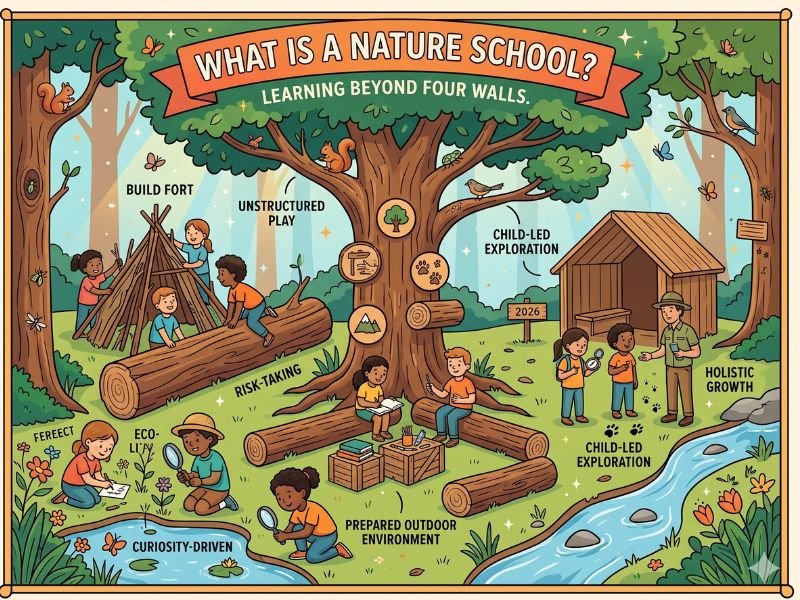
What is a Nature School? A Quick Definition
A nature school is an educational program where students spend the vast majority of their day—often 80% to 100%—learning outside in a natural environment.
Originating in Scandinavia in the 1950s, this approach believes that nature is the ultimate teacher. Instead of sitting at desks following a rigid, adult-led curriculum, children learn through unstructured play, exploration, and hands-on discovery in a forest, meadow, beach, or farm setting.
The 5 Core Pillars of a Nature School
If you observe a day at a nature school, it will look vastly different from a traditional preschool or kindergarten. Here are the five key elements that define the experience:
1. The Outdoors is the Classroom
There are no plastic toys or brightly colored posters. The environment is the learning material. A fallen log becomes a balance beam, a mud puddle becomes a science experiment, and a collection of rocks becomes a math lesson in sorting and counting.
2. Child-Led, Play-Based Learning
In a nature school, the curriculum is flexible. If the class finds a fascinating beetle on a morning hike, the entire lesson for the day might pivot to learning about insects, habitats, and counting legs. Learning is driven by the children’s natural curiosity rather than a strict lesson plan.
3. “No Bad Weather, Only Bad Clothing”
Rain, snow, or shine—nature school students are outside. A massive part of the program is teaching children how to dress appropriately for the elements (think thermal layers, waterproof rain suits, and sturdy boots). Experiencing all types of weather builds immense physical and mental resilience.
4. Calculated Risk-Taking
Traditional schools often try to eliminate all physical risks. Nature schools embrace calculated risks. Under careful adult supervision, children are encouraged to climb trees, balance on uneven terrain, use real tools (like basic whittling knives), and even help build small campfires. This teaches them to assess danger and trust their own physical abilities.
5. Teachers as “Guides”
Instructors in a forest school rarely stand at the front of a group to lecture. Instead, they act as facilitators or guides. They ensure the environment is safe, gently prompt the children with open-ended questions (e.g., “Why do you think that bird is making that sound?”), and help mediate social interactions.
Nature School vs. Traditional School: What’s the Difference?
To truly understand the forest school model, it helps to see how it compares to standard early childhood education.
| Feature | Traditional School | Nature / Forest School |
| The Environment | Indoors, structured classrooms, desks. | Outdoors, forests, parks, natural landscapes. |
| Learning Materials | Books, worksheets, plastic toys, screens. | Sticks, rocks, mud, water, flora, and fauna. |
| Curriculum Focus | Adult-led, standardized academic milestones. | Child-led, play-based, emerging from natural discovery. |
| Physical Activity | Scheduled recess (usually 30-60 minutes). | Constant movement over uneven terrain all day. |
| Weather Policy | Stay indoors during rain, snow, or extreme cold. | Go outside in almost all weather with proper gear. |
Top Benefits of Nature Education
Why are parents willing to deal with muddy boots and laundry every day? Because the research-backed benefits of outdoor education are massive:
-
Boosts Physical Health: Navigating uneven ground, climbing, and running significantly improves a child’s stamina, balance, and gross motor skills.
-
Improves Mental Well-being: Time spent in nature is scientifically proven to lower stress hormones, reduce anxiety, and improve focus (often decreasing symptoms of ADHD).
-
Develops Fierce Resilience: Learning to stay cheerful and active while it is raining or snowing teaches children that they can handle physical discomfort and adapt to changing situations.
-
Fosters High-Level Problem Solving: Because natural materials (like sticks and mud) don’t come with instructions, children have to use intense creativity and critical thinking to build forts or invent games.
Frequently Asked Questions (FAQs)
Do they learn to read and write in a nature school?
Yes, but not through traditional worksheets. Pre-literacy and pre-math skills are woven into play. Children might practice writing their names in the mud with a stick, count the number of acorns they collected, or listen to stories under a tree to build vocabulary.
Is it safe for children to be outside all day?
Absolutely. Nature school educators are highly trained in risk assessment and wilderness first aid. The environment is rigorously checked for severe hazards, and children are taught strict boundaries (e.g., how far they can roam and what plants they cannot touch).
What if it gets dangerously cold or stormy?
While the motto is “no bad weather,” nature schools prioritize safety. All legitimate programs have a safe, indoor shelter (like a yurt, cabin, or traditional building) where the class retreats during extreme weather events like lightning storms or dangerously freezing temperatures.
Final Thoughts
A nature school is more than just recess that lasts all day; it is a profound respect for a child’s need to move, explore, and connect with the world around them.
By removing the physical walls of a classroom, these programs remove the limits on a child’s imagination. If you want an educational foundation that prioritizes physical health, emotional resilience, and a deep love for the environment, a nature school might be the perfect adventure for your child.